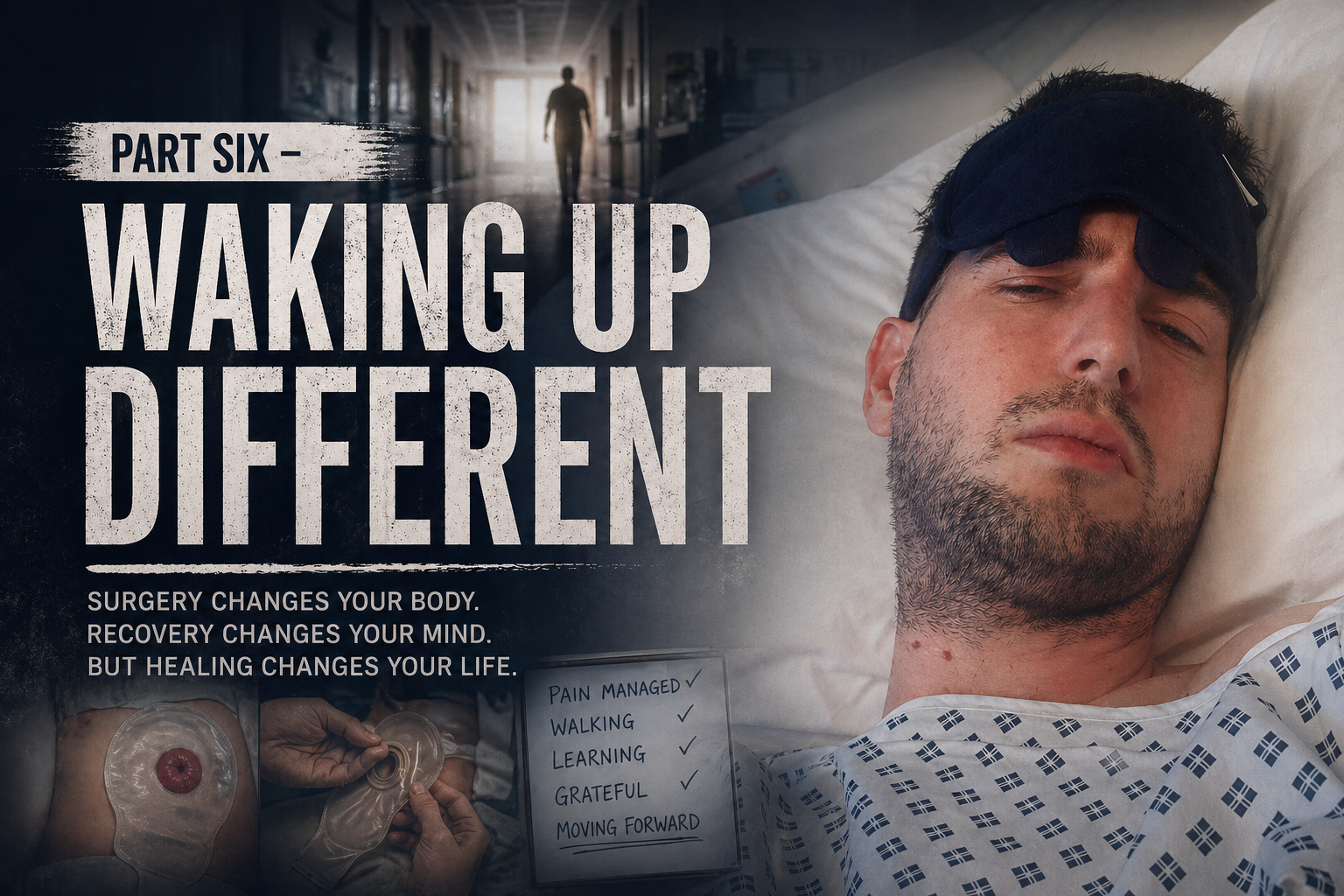
Chapter 32: Pain First
I woke up in pain.
Not gradually. Not quietly.
Instantly.
A deep, overwhelming pain across my abdomen that took my breath away before I’d even fully opened my eyes. It wasn’t confusion that brought me round — it was my body screaming that something major had happened.
I remember groaning. Trying to move. Immediately realising that was a mistake.
Someone was there quickly.
Painkillers were given — strong ones — and slowly, mercifully, the edge softened. The pain didn’t disappear, but it became survivable. Contained.
That’s when awareness started to creep in.
The surgery was over.
Chapter 33: Taking Stock
As the medication settled, I began to take stock of myself.
My mouth was dry. My throat sore from the tube. My stomach felt tight, heavy, and alien. Tubes ran in and out of me — cannula, catheter, drains — all doing jobs I couldn’t see.
Every breath felt deliberate.
I didn’t touch my stomach yet. I wasn’t ready.
I lay there listening to machines beep rhythmically, trying to calm my breathing and stay present.
I was alive.
And everything had changed.
Chapter 34: The Room
I wasn’t alone.
At first, I didn’t fully register the other bed in the room. But as hours passed, the reality of it became impossible to ignore.
The man beside me was dying.
There was a quiet urgency around his bed. Nurses came and went more frequently. Voices dropped. Movements became purposeful but gentle.
Family weren’t there — Covid rules meant no visitors — so he faced it with staff alone.
Lying there, drugged and in pain, listening to another human being reach the end of their life was surreal and deeply unsettling.
It stripped everything back.
Fear. Gratitude. Perspective. All tangled together.
Chapter 35: The Stoma Exists
At some point, a nurse mentioned it.
“Your stoma is working.”
Not asked. Not discussed. Stated.
I didn’t look straight away. I didn’t ask questions. I just absorbed the fact that something new was attached to me — something that would now keep me alive.
When I eventually glanced down, it was brief.
A clear bag. Red, swollen bowel beneath it. Movement.
I looked away.
That was enough for that day.
Chapter 36: Alone, Properly Alone
Covid meant no visitors.
No partner sitting by the bed.
No hand to hold.
No familiar face to ground me.
Phone calls helped — but they weren’t the same. I was processing something enormous largely on my own, surrounded by strangers and hospital noise.
Nights were the worst.
The ward never truly slept. Machines beeped. Staff whispered. The bag rustled softly as it filled.
And my thoughts ran wild.
Chapter 37: Pain, Managed
Pain became a routine rather than a shock.
Regular medication. Checks. Adjustments.
It was different from colitis pain — not cramping, not urgent — but surgical, deep, and relentless in its own way.
Every movement reminded me that my body had been opened and rearranged.
But even through the pain, I noticed something important.
The old pain wasn’t there.
No bowel spasms.
No urgency.
No bleeding.
That absence mattered.
Chapter 38: The First Walk
Then came the encouragement to move.
At first, the idea felt ridiculous. Standing felt impossible. Walking felt laughable.
But with help, I sat up.
Then stood.
Then took a few steps.
It was exhausting. Humbling. Painful.
But I did it.
Soon, walking laps of the ward became the goal.
Each lap was an achievement. A marker of progress. Proof that my body, despite everything, was still capable.
I counted them quietly, proud of something that would have once seemed insignificant.
Chapter 39: Learning the Bag
The stoma nurses arrived — calm, experienced, reassuring.
They didn’t overwhelm me. They focused on one thing at a time.
First: emptying the bag.
My hands shook the first time. Not from disgust, but from the weight of responsibility. This wasn’t temporary. This was mine now.
Later came changing it.
Measuring. Cutting. Cleaning. Sticking.
When the bag went on properly and held, I felt a small but powerful sense of achievement.
I was learning how to survive again.
Chapter 40: Discharge Without Readiness
When discharge was mentioned, it felt early.
Physically, I was improving. Mentally, I wasn’t sure I was ready.
Home meant no nurses. No backup. No reassurance that someone else would step in if something went wrong.
But home also meant safety. Familiarity. Love — even if still filtered through Covid restrictions.
Leaving hospital felt strange.
I walked out slower than I’d ever walked in.
Different.
Chapter 41: The Quiet Realisation
At home, things were awkward and slow.
Sleeping was uncomfortable. Eating felt cautious. Every action required thought.
But in the quiet moments, one truth became clear.
The disease was gone.
For the first time in years, my bowel wasn’t controlling my every decision.
I wasn’t healed.
But I wasn’t trapped anymore.