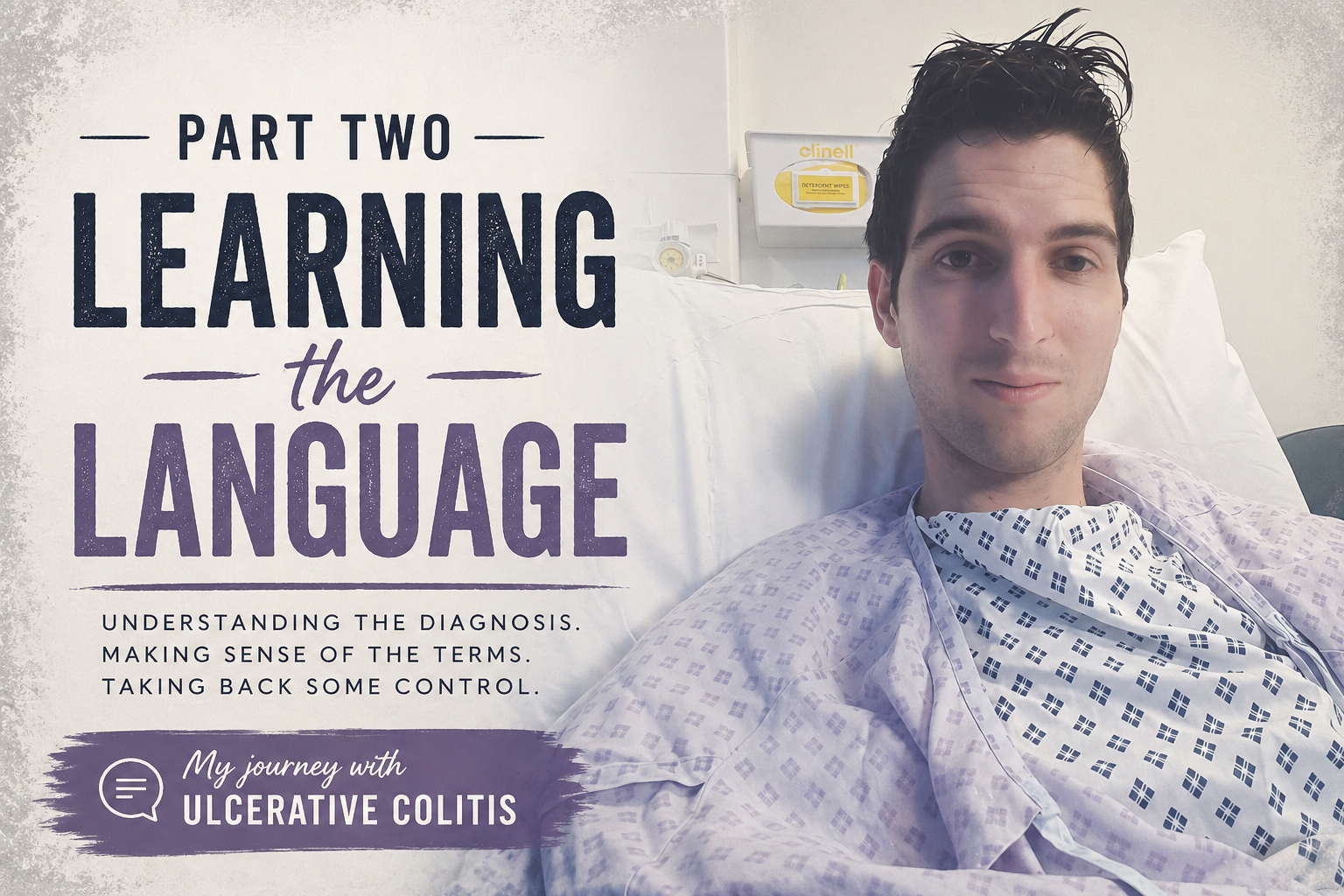
Chapter 6: Waiting With a Name
Being given a diagnosis didn’t bring relief in the way I expected.
Ulcerative colitis sounded serious — but vague. It wasn’t something people talked about openly, and it certainly wasn’t something I understood. I went home and did what most people do: I Googled it.
That was a mistake.
Pages of worst-case scenarios, words like chronic, lifelong, flare, and surgery jumped off the screen. None of it came with a clear explanation of what my life would actually look like.
So instead, I waited.
I waited for tests.
I waited for appointments.
I waited for reassurance.
In the meantime, my body continued to fall apart.
The Pentasa helped settle the worst of the bleeding, but I was still losing weight at an alarming rate. My clothes hung off me. People started commenting — not out of concern, but casually, as if weight loss was always a good thing.
It didn’t feel good.
I felt weak, drained, and permanently exhausted. Even simple tasks felt heavier than they should have.
Chapter 7: Ruling Out the Worst
The scan was arranged to rule out cancer.
By the time the day arrived, I barely recognised myself. I looked ill — properly ill — and that alone was terrifying. Walking into hospital felt different now. Less theoretical. More real.
Before the scan, I was given a large amount of contrast liquid to drink. No one really prepares you for how quickly it hits.
Within minutes, I desperately needed the toilet.
I was led into the scanning room, lay down on the table, and another plate was lowered onto my body. The machine felt tight, enclosed. A voice came through a speaker.
“If you need to stop the scan, press the emergency button.”
At that point, my main concern wasn’t panic — it was whether I’d wet myself.
The scanner roared into life, loud even with ear protection. The table moved. The machine clunked and buzzed around me. I lay still, trying to breathe through it, counting seconds and hoping it would end quickly.
When it was finally over, I rushed straight to the toilet — then another — then another.
Three days later, the phone rang.
“You’re all clear.”
I didn’t realise how much I’d been holding onto that fear until it was gone. The relief was overwhelming. Cancer was ruled out.
It felt like a win — even though nothing else had improved.
Chapter 8: Running on Empty
Despite the clear scan, I was still dangerously underweight.
Blood tests showed that my iron levels were critically low. No wonder I felt like I was running on fumes — there was barely anything left in the tank.
I was booked in for iron infusions.
Sitting there with a cannula in my arm while iron was pumped directly into my veins felt strange. Not painful — just surreal. Like my body had reached a point where it could no longer fix itself without help.
Within days, I noticed a difference.
Not a miracle recovery — but clarity. Energy. The fog lifting slightly. It was the first time in months that I felt even remotely like myself.
To help me regain weight, I was also prescribed high-calorie nutritional drinks. They tasted awful — thick, artificial, and sickly sweet — but I forced them down because I didn’t have much choice.
They worked.
Slowly, I stopped shrinking.
Chapter 9: The First Scope
Not long after, I met my consultant for the first time — the man who would become a constant presence in my life over the next several years.
He was calm, direct, and honest.
“We need to see how much of your bowel is affected,” he said.
“That means a colonoscopy.”
I already knew enough to dread that word.
He explained the procedure: a camera fed through the rectum, all the way around the colon to the appendix. I nodded as if I was fine with it, but inside I felt sick.
Then he handed me a box.
Picolax.
If you’ve never had bowel prep, it’s hard to explain just how grim it is. It’s not just drinking something unpleasant — it’s surrendering control completely.
The taste was vile. Chemical. Unforgettable. Even now, years later, the smell alone is enough to turn my stomach.
Once it starts working, there’s no pause button. I was emptied out completely, over and over again, until there was nothing left.
By the time the procedure day arrived, I was starving, dehydrated, and anxious.
Chapter 10: Mild
The procedure room was filled with screens and equipment. I was given a gown and told to lie on my side, dignity officially gone.
Sedation was administered, and a heavy, drunken feeling washed over me. The world blurred. The ceiling faded.
When I came round, I knew immediately that it hadn’t been pleasant — even if I couldn’t remember most of it.
In recovery, I was given tea and toast and left to wait for the results.
The consultant came over.
“At the moment, you have mild ulcerative colitis,” he said.
“It’s confined to the rectum — proctitis.”
Mild.
It sounded reassuring. Comforting, even.
He explained that ulcerative colitis was an autoimmune disease — my immune system was mistakenly attacking my own bowel. There was no cure, but it could be managed with medication.
“We’ll try different treatments until we find what works for you,” he said.
“But every drug comes with risks.”
At that moment, the risks didn’t matter.
All I heard was manageable.
I walked out believing the worst was behind me.