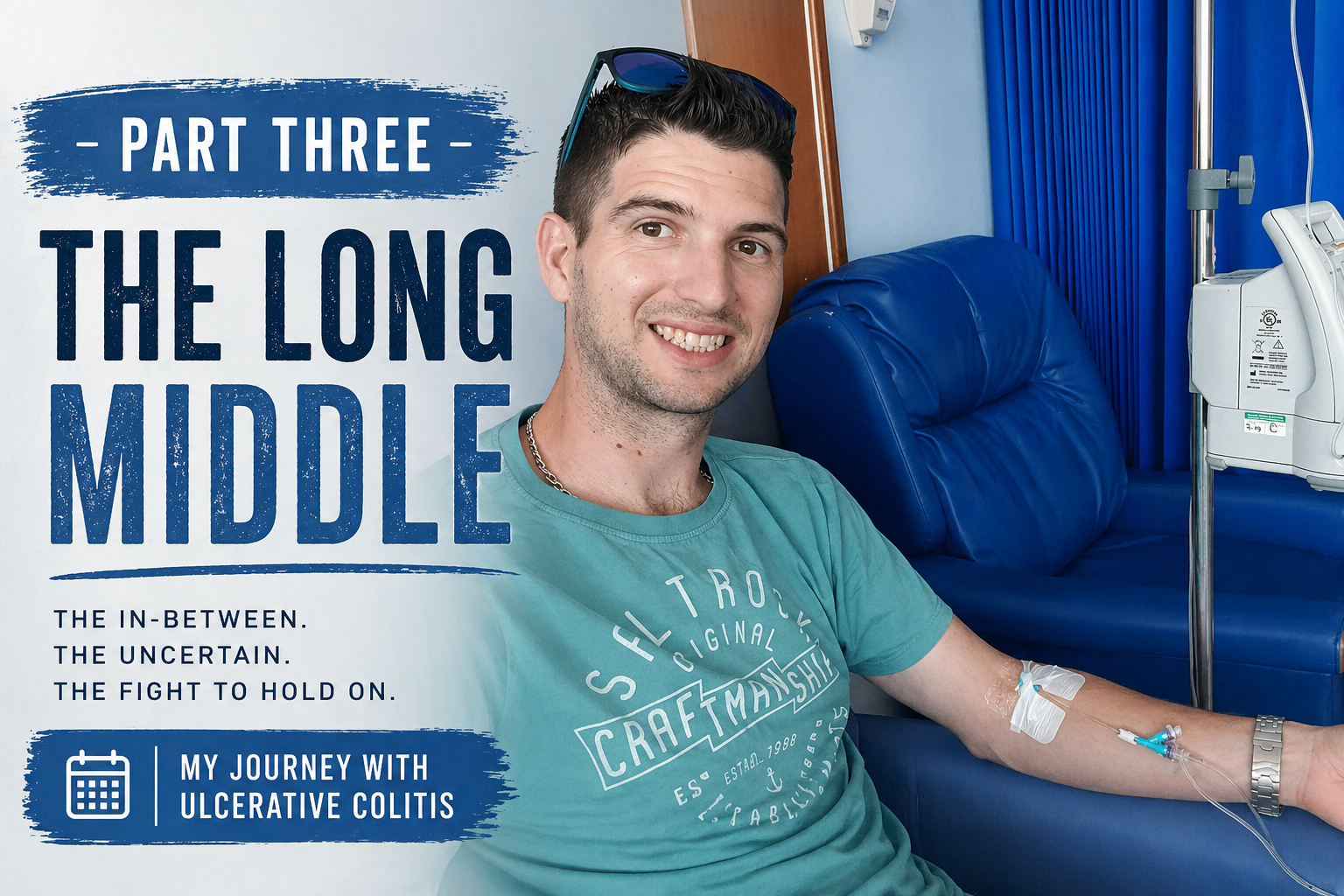
PART THREE – THE LONG MIDDLE

Chapter 11: Learning to Live With It

After the colonoscopy, life didn’t stop — it just changed quietly in the background.

On paper, I had mild ulcerative colitis. In reality, I had a condition that needed managing every single day. I was sent home with Pentasa suppositories and told to use them nightly.

That alone was a learning curve.

There’s nothing quite like ending every evening inserting medication into your own backside to remind you that life has shifted slightly off course. It was awkward at first, uncomfortable, and undeniably unglamorous — but it worked.

The bleeding reduced.

The mucus eased.

Things felt… stable.

Not perfect — but livable.

I returned to work at Waitrose, trying to pretend that nothing significant had changed. I had a family to support, a routine to keep, and a life that needed normality.

And for a while, normality returned.

Chapter 12: The First Cracks

Over time, small things began to creep back in.

Urgency.

Fatigue.

The quiet anxiety of not trusting your own body.

At first, it was easy to brush off. Everyone has bad days. Everyone gets tired. But I knew the signs now, and deep down I recognised them.

Blood started appearing again.

Mucus followed.

Back to the hospital.

This time, the conversations felt different — more cautious. The language changed slightly. Words like escalation and next steps entered the room.

The next drug was Azathioprine — an immunosuppressant designed to calm the immune system down.

I took it alongside the Pentasa, hopeful that this combination would finally keep things under control.

It didn’t.

Chapter 13: Enter the Steroids

When Azathioprine failed, Prednisolone entered my life.

Steroids work fast. Brutally fast.

Within days, the flare settled. The bleeding stopped. The urgency disappeared. Physically, I felt better almost overnight.

Mentally, I became someone else.

I didn’t sleep.

I was wired constantly.

I was angry — for no reason.

I’ve always been a calm, level-headed person, so this version of me felt foreign and unsettling. I snapped. I paced. My thoughts raced endlessly.

But the symptoms were gone.

And at that stage, that was all that mattered.

Chapter 14: When It Comes Back Harder

Steroids aren’t a solution — they’re a pause button.

Once the course ended, the disease returned.

This time, it didn’t creep in politely.

It arrived full force.

I was going to the toilet up to fifteen times a day. It wasn’t just stool — it was blood and mucus, every single time. The urgency was relentless. I barely trusted myself to leave the house.

Sleep was broken.

Energy vanished.

Life shrank.

I was introduced to Methotrexate next — self-administered injections into my stomach using EpiPens delivered to my house.

Oddly enough, the injections themselves weren’t the problem.

The side effects were.

Chapter 15: The Lowest Point

Methotrexate stripped me down completely.

Physically, I felt poisoned.

Mentally, I felt hollow.

I was still symptomatic, still exhausted, still bleeding — but now I also felt emotionally numb and fragile. Even the smell of the alcohol wipes used before injections made me gag.

One evening, I looked at my partner and said the words that had been quietly forming in my head for months:

“I can’t live like this.”

That was the first time surgery entered the conversation seriously.

Not as a future possibility — but as something I wanted.

We turned up at the hospital unannounced, desperate for answers. By chance, the consultant team were in a meeting, and my case was discussed there and then.

When the meeting finished, we were called in.

That’s when my consultant’s boss spoke.

She explained the surgery process — calmly, clearly — and for the first time, it didn’t sound terrifying.

Then she said something that stopped everything in its tracks.

“There is one more drug we’d like to try.”

Chapter 16: One More Chance

The drug was called Vedolizumab.

A long name. A new hope.

It was newer for colitis, more established in Crohn’s disease, and designed to be gut-specific — meaning it targeted the bowel without suppressing the entire immune system.

The plan was to start Vedolizumab while I was still tapering off steroids, keeping Methotrexate running temporarily to stop my immune system from rejecting it.

At that point, I didn’t care.

If this was the last hurdle before surgery, I was ready to jump it.

The first infusion took place in hospital. A cannula in my arm, a drip stand beside me, and an hour watching medication flow slowly into my veins.

I’d read the side effects beforehand — a mistake.

Every twinge felt suspicious. Every sensation felt exaggerated. By the end, I was lightheaded and cautious, sitting in the car before driving home, taking no risks.

That weekend, we went away to Woolacombe Bay with family and close friends — a short break to breathe and forget everything for a moment.

It was on the way home that everything changed.

Chapter 17: Starcross

Driving home, the familiar urgency hit.

I spotted Exeter services too late. Missed the turning. Panic rose.

Back roads. Dawlish. Starcross.

I remembered there were toilets at the train station.

I pulled into the car park across three spaces and ran.

What happened next still feels surreal.

For the first time in months, what came out was solid. Formed. Normal.

No blood.

No mucus.

No urgency afterwards.

I sat there in disbelief.

Vedolizumab had worked.

Chapter 18: Four Years of Breathing

Methotrexate was stopped.

Vedolizumab continued every eight weeks.

For four years, I lived symptom-free.

My consultant still talks about how quickly my body responded. How rare it was. How happy they were to see me get my life back.

And I did.

I worked nights at Waitrose.

I lived normally.

I planned a future.

My health was stable — for the first time since diagnosis.

And because I finally felt well, I made a decision that would shape the rest of my life.

It was time to build a career.
PART TWO – LEARNING THE LANGUAGE

Chapter 6: Waiting With a Name

Being given a diagnosis didn’t bring relief in the way I expected.

Ulcerative colitis sounded serious — but vague. It wasn’t something people talked about openly, and it certainly wasn’t something I understood. I went home and did what most people do: I Googled it.

That was a mistake.

Pages of worst-case scenarios, words like chronic, lifelong, flare, and surgery jumped off the screen. None of it came with a clear explanation of what my life would actually look like.

So instead, I waited.

I waited for tests.

I waited for appointments.

I waited for reassurance.

In the meantime, my body continued to fall apart.

The Pentasa helped settle the worst of the bleeding, but I was still losing weight at an alarming rate. My clothes hung off me. People started commenting — not out of concern, but casually, as if weight loss was always a good thing.

It didn’t feel good.

I felt weak, drained, and permanently exhausted. Even simple tasks felt heavier than they should have.

Chapter 7: Ruling Out the Worst

The scan was arranged to rule out cancer.

By the time the day arrived, I barely recognised myself. I looked ill — properly ill — and that alone was terrifying. Walking into hospital felt different now. Less theoretical. More real.

Before the scan, I was given a large amount of contrast liquid to drink. No one really prepares you for how quickly it hits.

Within minutes, I desperately needed the toilet.

I was led into the scanning room, lay down on the table, and another plate was lowered onto my body. The machine felt tight, enclosed. A voice came through a speaker.

“If you need to stop the scan, press the emergency button.”

At that point, my main concern wasn’t panic — it was whether I’d wet myself.

The scanner roared into life, loud even with ear protection. The table moved. The machine clunked and buzzed around me. I lay still, trying to breathe through it, counting seconds and hoping it would end quickly.

When it was finally over, I rushed straight to the toilet — then another — then another.

Three days later, the phone rang.

“You’re all clear.”

I didn’t realise how much I’d been holding onto that fear until it was gone. The relief was overwhelming. Cancer was ruled out.

It felt like a win — even though nothing else had improved.

Chapter 8: Running on Empty

Despite the clear scan, I was still dangerously underweight.

Blood tests showed that my iron levels were critically low. No wonder I felt like I was running on fumes — there was barely anything left in the tank.

I was booked in for iron infusions.

Sitting there with a cannula in my arm while iron was pumped directly into my veins felt strange. Not painful — just surreal. Like my body had reached a point where it could no longer fix itself without help.

Within days, I noticed a difference.

Not a miracle recovery — but clarity. Energy. The fog lifting slightly. It was the first time in months that I felt even remotely like myself.

To help me regain weight, I was also prescribed high-calorie nutritional drinks. They tasted awful — thick, artificial, and sickly sweet — but I forced them down because I didn’t have much choice.

They worked.

Slowly, I stopped shrinking.

Chapter 9: The First Scope

Not long after, I met my consultant for the first time — the man who would become a constant presence in my life over the next several years.

He was calm, direct, and honest.

“We need to see how much of your bowel is affected,” he said.

“That means a colonoscopy.”

I already knew enough to dread that word.

He explained the procedure: a camera fed through the rectum, all the way around the colon to the appendix. I nodded as if I was fine with it, but inside I felt sick.

Then he handed me a box.

Picolax.

If you’ve never had bowel prep, it’s hard to explain just how grim it is. It’s not just drinking something unpleasant — it’s surrendering control completely.

The taste was vile. Chemical. Unforgettable. Even now, years later, the smell alone is enough to turn my stomach.

Once it starts working, there’s no pause button. I was emptied out completely, over and over again, until there was nothing left.

By the time the procedure day arrived, I was starving, dehydrated, and anxious.

Chapter 10: Mild

The procedure room was filled with screens and equipment. I was given a gown and told to lie on my side, dignity officially gone.

Sedation was administered, and a heavy, drunken feeling washed over me. The world blurred. The ceiling faded.

When I came round, I knew immediately that it hadn’t been pleasant — even if I couldn’t remember most of it.

In recovery, I was given tea and toast and left to wait for the results.

The consultant came over.

“At the moment, you have mild ulcerative colitis,” he said.

“It’s confined to the rectum — proctitis.”

Mild.

It sounded reassuring. Comforting, even.

He explained that ulcerative colitis was an autoimmune disease — my immune system was mistakenly attacking my own bowel. There was no cure, but it could be managed with medication.

“We’ll try different treatments until we find what works for you,” he said.

“But every drug comes with risks.”

At that moment, the risks didn’t matter.

All I heard was manageable.

I walked out believing the worst was behind me.

PART ONE – BEFORE I LISTENED

Chapter 1: It Wasn’t Haemorrhoids

My story didn’t start with a dramatic collapse or a blue-light ambulance ride.

It started with something far less urgent — and far easier to ignore.

In 2013, when I was 26, I began noticing changes when I went to the toilet. At first, it was constipation. Then white streaks on my stool. I didn’t know it at the time, but that white substance was mucus — something your colon produces when it’s inflamed and trying to protect itself.

Back then, I didn’t Google symptoms or push for answers. I did what a lot of men do: I noticed it, decided it was probably nothing, and carried on.

Looking back, that was my first mistake.

Talking about poo is still strangely taboo. We all do it every day, yet the moment something changes, embarrassment kicks in. I was a young bloke, working, raising a family, busy with life. Whatever was going on down there didn’t feel important enough to stop everything else.

So I ignored it.

Life carried on. I had a partner I loved, and between us we were raising four children full-time. We’d also just welcomed a daughter together, bringing our total to five. I was working at Waitrose, which had recently replaced the old Co-op in town, and on the surface everything looked fine.

But my body was quietly disagreeing.

Chapter 2: Hoping It Would Go Away

The symptoms didn’t disappear.

They escalated.

The mucus became more frequent, and then blood appeared. Bright red. Impossible to ignore — yet I still tried. I convinced myself it must be something simple. Something explainable. A reaction to food. A dodgy takeaway. A spicy meat feast pizza became the convenient villain.

Deep down, I knew better.

My partner noticed before I admitted it. She saw the weight dropping off me. Saw how often I was disappearing to the toilet. Eventually, she pushed me to see the GP.

I didn’t want to go.

There’s something uniquely uncomfortable about explaining bowel symptoms out loud, especially when you’re not even sure how to describe them yourself. But I went.

The verdict was quick.

“Sounds like piles.”

I walked out of the surgery holding a prescription for Anusol, feeling a strange mix of relief and disbelief. Haemorrhoids weren’t serious. They weren’t life-changing. They were something people joked about.

So I accepted it.

I applied the cream, endured the indignity of it, and waited for things to improve.

They didn’t.

If anything, they got worse.

Chapter 3: When Something Felt Wrong

A week passed. Then another.

Nothing changed — except my anxiety.

I went back to the GP, this time more determined. Something wasn’t right, and I needed someone to take it seriously. I was referred to gastroenterology, but like most NHS referrals, it came with a wait.

While I waited, my condition deteriorated quickly.

I reached a point where I couldn’t even pass wind without mucus being released. I was losing weight without trying. My energy drained away, and food seemed to pass straight through me.

That’s when the thought I’d been avoiding finally surfaced.

Cancer.

Once that word enters your head, it doesn’t leave quietly. It sits there, replaying itself during long nights and silent moments. Every symptom suddenly feels heavier.

By the time my hospital appointment came through, I was already braced for bad news.

Chapter 4: Level 8

My partner and I arrived at the hospital and made our way up to Level 8. We took the stairs — not out of fitness, but because she hates lifts. At the time, it felt like a pointless detail. Later, it would become one of those memories that sticks.

We checked in and waited.

Eventually, a nurse called us into a small consultation room. I explained everything — properly this time. No minimising. No embarrassment. Just the facts.

She listened carefully, then said the sentence that made my stomach drop.

“We need to make sure this isn’t cancer. We can’t rule that out yet.”

I barely had time to process that before she continued.

“I need to examine you.”

She drew a curtain and reached for a long, cold, metallic instrument — something that looked more like a transformer than a medical device. In that moment, it became painfully clear that this appointment was about to cross several personal boundaries.

I was mortified.

But there was no alternative.

The examination was brief, uncomfortable, and unforgettable — the first of many moments where dignity became secondary to answers.

When it was over, she was clear.

“There are no haemorrhoids. What you’re describing is consistent with ulcerative colitis.”

I finally had a name.

But I had no idea what it meant.

Chapter 5: A Name, Not a Solution

Ulcerative colitis.

She explained that it was a form of inflammatory bowel disease — an autoimmune condition where the body attacks its own colon. She also explained that more tests were needed to confirm the diagnosis and rule out cancer.

At that point, I didn’t care about the details.

I just wanted reassurance that I wasn’t dying.

I was prescribed Pentasa (mesalazine) suppositories and sent home to wait for further tests. The medication worked, at least partially. The bleeding eased. The mucus reduced.

But the weight didn’t come back.

And the fear didn’t leave.