This is the closing reflection on my ulcerative colitis to stoma journey — from the early symptoms I ignored, to diagnosis, medication, remission, relapse, hospital admissions, stoma surgery, recovery, and learning to live again. It is not a neat or simple story, but it is the full journey of how ulcerative colitis changed my body, my confidence, my future, and eventually gave me a voice through The Stoma Accountant.
This page brings the whole journey together in one place, including the symptoms I ignored, what happened after diagnosis, the long years of living with ulcerative colitis, the flare that changed everything, preparing for surgery, waking up with a stoma and learning who I am now.
This follows on from A Call to Hope, where I shared a message for anyone living with ulcerative colitis, facing stoma surgery, recovering with a stoma, or wondering whether life can feel normal again.
Read A Call to Hope here:
Life After Stoma Surgery With Ulcerative Colitis
Closing Reflection – The Whole Journey
My journey with ulcerative colitis didn’t follow a straight line.
The Early Ulcerative Colitis Symptoms I Ignored
It didn’t begin with some dramatic collapse or obvious medical emergency. It began quietly, with symptoms that were easy to dismiss because they were awkward, embarrassing, and not the sort of thing people naturally want to talk about. At the start, I wanted to believe it was something simple. Something that would go away. Something I could ignore until life carried on as normal.
That is why I started this story by writing about the ulcerative colitis symptoms I ignored before diagnosis.
But that isn’t how it happened.
From Diagnosis to Medication and False Hope
What started as mucus, blood, weight loss and fear slowly turned into years of appointments, medications, scans, scopes, hospital rooms, false hope, side effects, and setbacks. Before the medication journey truly began, I had to understand what happened after my ulcerative colitis diagnosis and what those first hospital appointments meant.
There were moments where treatment worked and I thought I had finally found solid ground. There were also moments where drugs failed spectacularly and pulled that ground away again.
That is one of the hardest parts of living with a condition like ulcerative colitis. It doesn’t just affect your body. It affects your ability to trust life.
You learn not to get too comfortable. You learn that a good few weeks doesn’t always mean the storm has passed. You learn that a medication working today doesn’t guarantee it will work forever. You learn to live with hope, but also with caution, because you have been disappointed before.
Vedolizumab gave me four years of life back, and I will always be grateful for that. Those years were part of learning what living with ulcerative colitis after diagnosis really meant. Those years mattered. They gave me room to breathe, room to work, room to study, room to start building a career, and room to remember that I was more than a disease. For a while, I wasn’t just surviving. I was moving forward.
When Ulcerative Colitis Took Control Again
Then Covid arrived, my treatment stopped holding things together, and the stability I had built began to fall apart again.
That was the start of my ulcerative colitis flare after remission, when symptoms returned and the life I had rebuilt began to shrink again.
I lost control in ways I never imagined I would. I planned routes around toilets and bushes. I carried a rescue pack. I wore protective underwear. I sat in traffic terrified of what my body might do. I lost work, delayed plans, fought through exams, and kept trying to build a future while my body was pulling me backwards.
Eventually, my body made the decision that medicine no longer could.
When Stoma Surgery Became Hope
Surgery wasn’t a dramatic rescue. It wasn’t the easy option, and it definitely wasn’t a failure.
Once surgery became the next step, preparing for stoma surgery with ulcerative colitis became its own emotional part of the journey.
It was the necessary step after everything else had been tried. It was the moment where keeping my colon was costing me more than losing it.
That is a hard thing to explain unless you have lived it.
From the outside, surgery can sound like the worst-case scenario. From the inside, when your quality of life has been stripped down to pain, urgency, accidents, fear and exhaustion, surgery can start to look like hope. Not simple hope. Not easy hope. But hope all the same.
Learning to Live With a Stoma
What followed wasn’t instant freedom.
I woke up in pain.
That first stage was my stoma surgery recovery after ulcerative colitis, and it was where I began learning my new body from the beginning.
I had to learn my body all over again. I had to face a stoma, a bag, scars, weakness, and a version of myself I didn’t fully recognise at first. I had to learn how to empty the bag, change it, trust it, dress with it, sleep with it, and live with it. I had to rebuild physically and mentally, one small milestone at a time.
But slowly, something shifted.
I realised I wasn’t planning toilet routes anymore. I wasn’t bleeding. I wasn’t living in constant fear of accidents. I wasn’t carrying the same panic into every car journey, every dog walk, every day out, or every normal family moment. My body was different, yes, but my life was wider again.
Over time, that became the process of adjusting to life with a stoma after surgery.
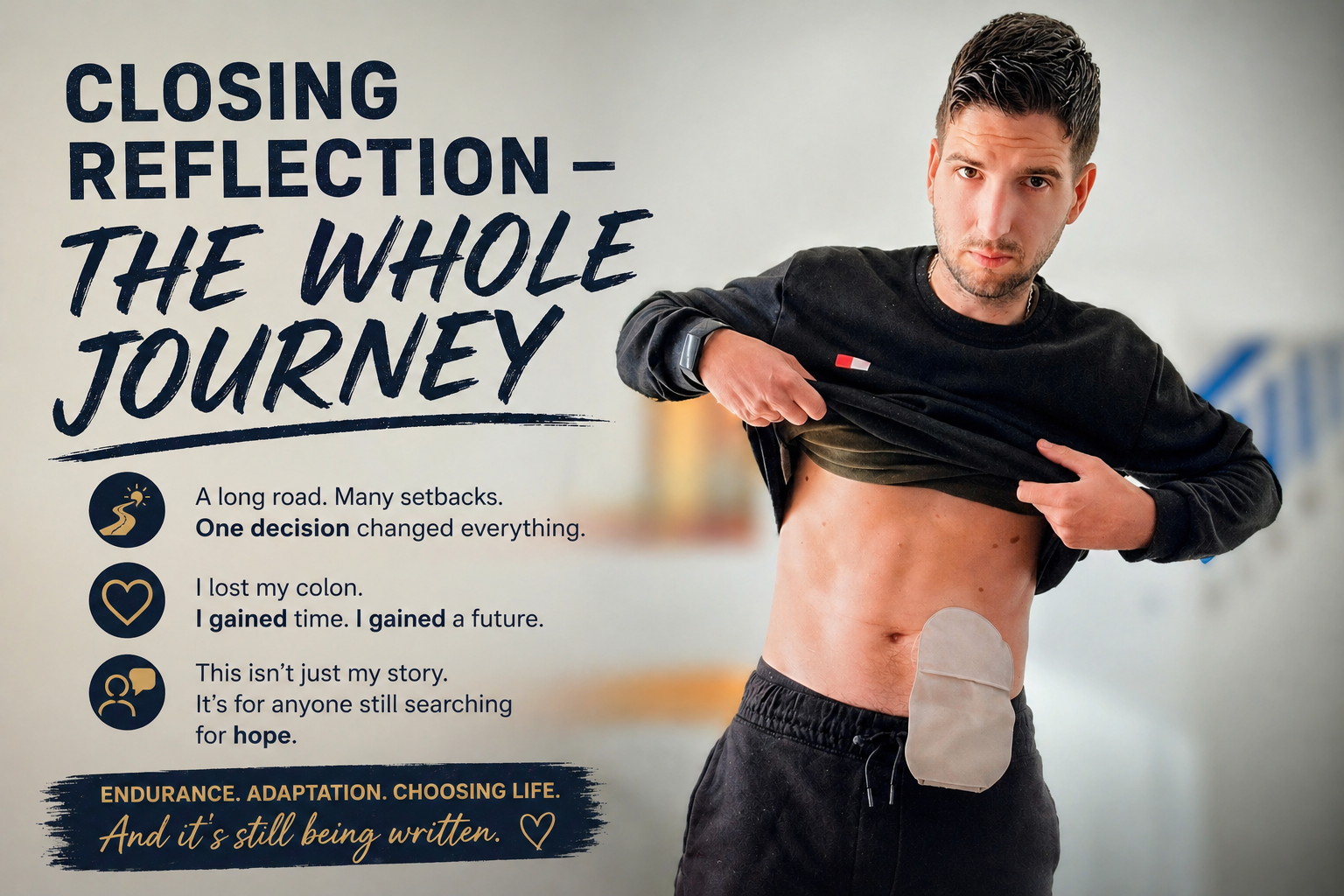
I lost my colon, but I gained time.
I lost the version of my body I had always known, but I gained a future that felt possible again.
What Ulcerative Colitis Took From Me
That doesn’t mean I am grateful for everything that happened. I don’t think we always need to wrap trauma up in a neat bow and pretend every painful thing was secretly a gift. Ulcerative colitis took a lot from me. It took confidence, energy, dignity, jobs, plans, time with my family, and years where I should have been living rather than surviving.
But I can say this: it didn’t take everything.
It didn’t take my humour. It didn’t take my determination. It didn’t take my ability to rebuild. And, eventually, it gave me a reason to speak openly about things I once felt too embarrassed to say out loud.
Living with a stoma isn’t the story people always expect to hear, but it is the story that gave me my life back. More than that, it gave me a voice.
Why I Started The Stoma Accountant
That voice became The Stoma Accountant.
At first, I created this blog as a way to document what was happening and cope with something that felt bigger than me. I wanted somewhere to put the fear, the practical details, the emotional bits, and the reality of what it was like to go from ulcerative colitis to surgery and life with a stoma. I didn’t know whether anyone would read it. I didn’t know whether it would matter to anyone else.
But if sharing this helps even one person feel less alone, less afraid, or more informed about their choices, then every difficult part of this journey has meaning beyond me.
Because this was never just a story about illness.
It is a story about ignoring symptoms until you can’t anymore. It is a story about embarrassment turning into fear, fear turning into answers, and answers turning into a long road you never expected to walk. It is a story about medication working, medication failing, and learning that hope can come in different forms.
It is a story about family, work, studying, setbacks, surgery, recovery, humour, dignity, and finding yourself again after your body changes.
Most of all, it is a story about endurance and adaptation.
I am not the same person I was before ulcerative colitis. I am not the same person I was before surgery either. But maybe that is the point. Maybe the goal was never to get back to who I was before all of this happened. Maybe the goal was to become someone who survived it, learned from it, and found a way to use it.
My Story Did Not End With Surgery
My story didn’t end with surgery.
It finally had room to continue.
And it is still being written.
Contact your GP or medical team
This is my personal experience of ulcerative colitis, stoma surgery, recovery and learning to live with a stoma. It is not medical advice.
If you are experiencing symptoms, facing surgery, recovering with a stoma, struggling with your mental health after diagnosis or treatment, or unsure about your own care, please speak to your GP, consultant, IBD team, surgeon or stoma nurse.
You can also read Crohn’s & Colitis UK guidance on life with a stoma.
You can also read NHS guidance on recovering after an ileostomy.