Chapter 11: Learning to Live With It
After the colonoscopy, life didn’t stop — it just changed quietly in the background.
On paper, I had mild ulcerative colitis. In reality, I had a condition that needed managing every single day. I was sent home with Pentasa suppositories and told to use them nightly.
That alone was a learning curve.
There’s nothing quite like ending every evening inserting medication into your own backside to remind you that life has shifted slightly off course. It was awkward at first, uncomfortable, and undeniably unglamorous — but it worked.
The bleeding reduced.
The mucus eased.
Things felt… stable.
Not perfect — but livable.
I returned to work at Waitrose, trying to pretend that nothing significant had changed. I had a family to support, a routine to keep, and a life that needed normality.
And for a while, normality returned.
Chapter 12: The First Cracks
Over time, small things began to creep back in.
Urgency.
Fatigue.
The quiet anxiety of not trusting your own body.
At first, it was easy to brush off. Everyone has bad days. Everyone gets tired. But I knew the signs now, and deep down I recognised them.
Blood started appearing again.
Mucus followed.
Back to the hospital.
This time, the conversations felt different — more cautious. The language changed slightly. Words like escalation and next steps entered the room.
The next drug was Azathioprine — an immunosuppressant designed to calm the immune system down.
I took it alongside the Pentasa, hopeful that this combination would finally keep things under control.
It didn’t.
Chapter 13: Enter the Steroids
When Azathioprine failed, Prednisolone entered my life.
Steroids work fast. Brutally fast.
Within days, the flare settled. The bleeding stopped. The urgency disappeared. Physically, I felt better almost overnight.
Mentally, I became someone else.
I didn’t sleep.
I was wired constantly.
I was angry — for no reason.
I’ve always been a calm, level-headed person, so this version of me felt foreign and unsettling. I snapped. I paced. My thoughts raced endlessly.
But the symptoms were gone.
And at that stage, that was all that mattered.
Chapter 14: When It Comes Back Harder
Steroids aren’t a solution — they’re a pause button.
Once the course ended, the disease returned.
This time, it didn’t creep in politely.
It arrived full force.
I was going to the toilet up to fifteen times a day. It wasn’t just stool — it was blood and mucus, every single time. The urgency was relentless. I barely trusted myself to leave the house.
Sleep was broken.
Energy vanished.
Life shrank.
I was introduced to Methotrexate next — self-administered injections into my stomach using EpiPens delivered to my house.
Oddly enough, the injections themselves weren’t the problem.
The side effects were.
Chapter 15: The Lowest Point
Methotrexate stripped me down completely.
Physically, I felt poisoned.
Mentally, I felt hollow.
I was still symptomatic, still exhausted, still bleeding — but now I also felt emotionally numb and fragile. Even the smell of the alcohol wipes used before injections made me gag.
One evening, I looked at my partner and said the words that had been quietly forming in my head for months:
“I can’t live like this.”
That was the first time surgery entered the conversation seriously.
Not as a future possibility — but as something I wanted.
We turned up at the hospital unannounced, desperate for answers. By chance, the consultant team were in a meeting, and my case was discussed there and then.
When the meeting finished, we were called in.
That’s when my consultant’s boss spoke.
She explained the surgery process — calmly, clearly — and for the first time, it didn’t sound terrifying.
Then she said something that stopped everything in its tracks.
“There is one more drug we’d like to try.”
Chapter 16: One More Chance
The drug was called Vedolizumab.
A long name. A new hope.
It was newer for colitis, more established in Crohn’s disease, and designed to be gut-specific — meaning it targeted the bowel without suppressing the entire immune system.
The plan was to start Vedolizumab while I was still tapering off steroids, keeping Methotrexate running temporarily to stop my immune system from rejecting it.
At that point, I didn’t care.
If this was the last hurdle before surgery, I was ready to jump it.
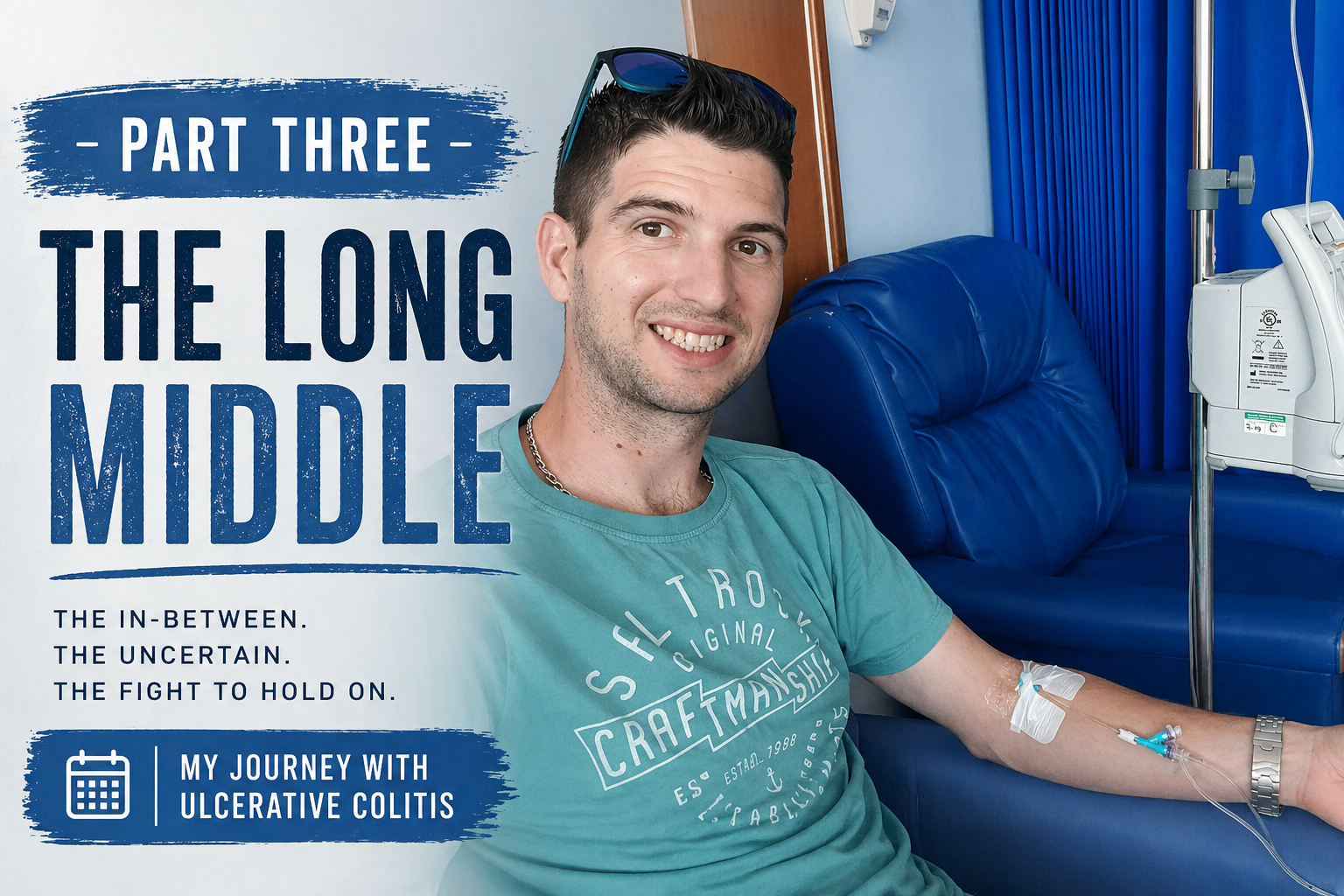
The first infusion took place in hospital. A cannula in my arm, a drip stand beside me, and an hour watching medication flow slowly into my veins.
I’d read the side effects beforehand — a mistake.
Every twinge felt suspicious. Every sensation felt exaggerated. By the end, I was lightheaded and cautious, sitting in the car before driving home, taking no risks.
That weekend, we went away to Woolacombe Bay with family and close friends — a short break to breathe and forget everything for a moment.
It was on the way home that everything changed.
Chapter 17: Starcross
Driving home, the familiar urgency hit.
I spotted Exeter services too late. Missed the turning. Panic rose.
Back roads. Dawlish. Starcross.
I remembered there were toilets at the train station.
I pulled into the car park across three spaces and ran.
What happened next still feels surreal.
For the first time in months, what came out was solid. Formed. Normal.
No blood.
No mucus.
No urgency afterwards.
I sat there in disbelief.
Vedolizumab had worked.
Chapter 18: Four Years of Breathing
Methotrexate was stopped.
Vedolizumab continued every eight weeks.
For four years, I lived symptom-free.
My consultant still talks about how quickly my body responded. How rare it was. How happy they were to see me get my life back.
And I did.
I worked nights at Waitrose.
I lived normally.
I planned a future.
My health was stable — for the first time since diagnosis.
And because I finally felt well, I made a decision that would shape the rest of my life.
It was time to build a career.